How to Destroy a Forest

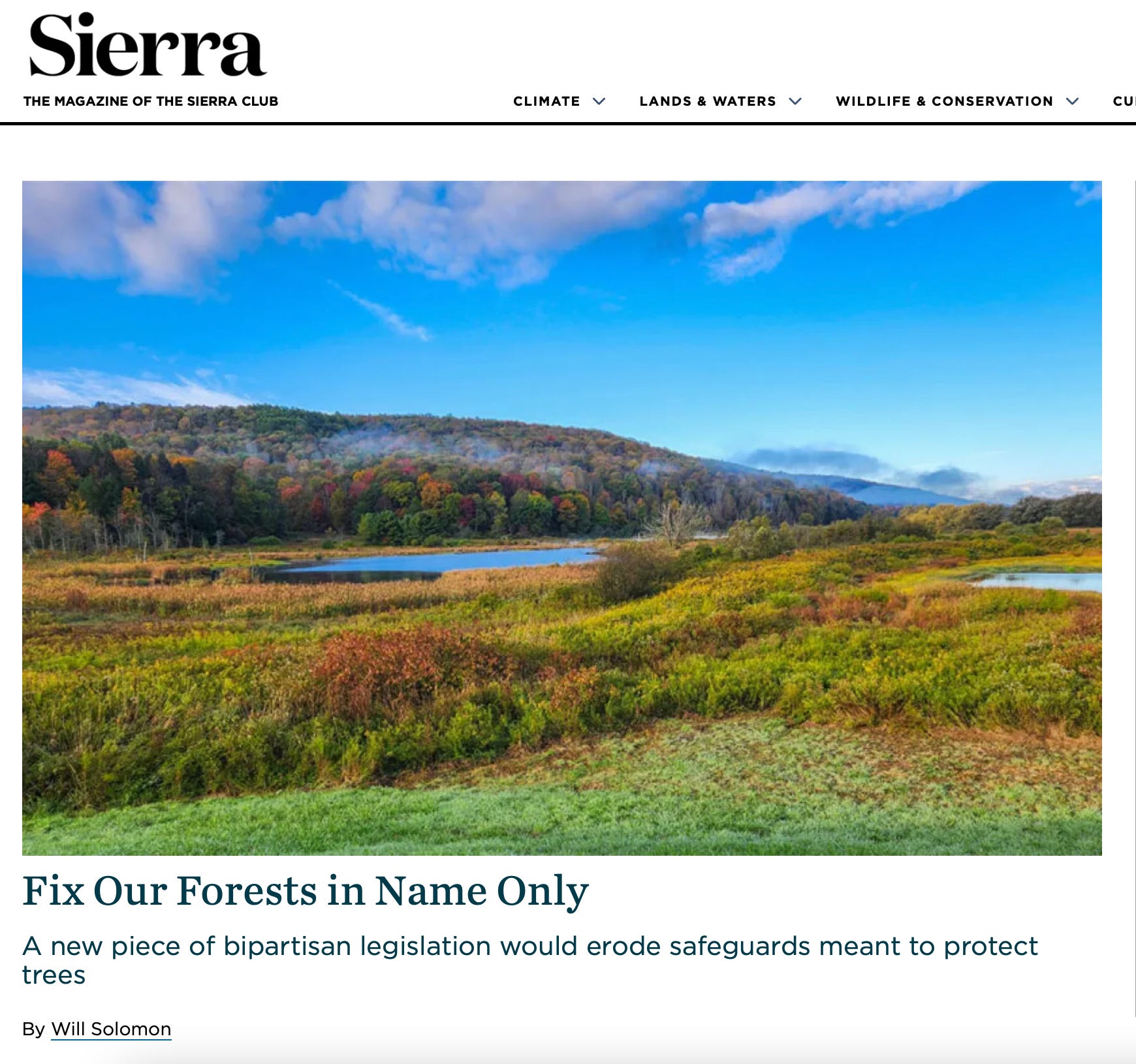
I’ve got a new story running in Sierra Magazine on the Fix Our Forests Act (somehow its real name), a bill which would gut the rather minimal protections American forests still have. Plenty of Democrats on board with it, by the way.
For Porter, DellaSala, and Ingalsbee, the issue is ultimately bigger than FOFA. It’s the confluence of a range of Trump administration policies that are handing even more control of public lands to industry, limiting public insight, and collectively worsening ecological health through a dramatic intensification of long-standing destructive policies. They point to the Roadless Rule rescission, along with Trump’s Executive Order 14225, titled Immediate Expansion of American Timber Production, as a sort of perfect storm of environmental harm that may lead to vastly more logging in some of the nation’s oldest and wildest forests—all more or less undertaken under the guise of so-called responsible land management.
I have previously written about this broad issue, or at least its manifestation here in Vermont, twice for Earth Island Journal—read those here and here.
Also on the subject of forest health, and also in Sierra, here is a more positive spin from Krista Langlois: “The Northeast Has Unexpected Old-Growth Forests That Survived Colonial Axes.”
The first thing I noticed was what was absent. Gone were the choking vines, the creep of poison ivy, the clawing branches. Gone was the claustrophobic competition for light and space. Instead, the forest floor was as open as a park, threaded by wandering streams. It was so thoroughly shaded that the only under-story plants were delicate ferns, lady’s slipper orchids, and trillium. Mosses smothered tree trunks. Lichens clung to boulders. Although I couldn’t immediately put my finger on what it was, something felt different. This is how many people describe their first encounter with northeastern old growth: an intangible sensation that precedes any quantifiable observation. They simply feel that they’re in the presence of something ancient.
That summer, New England had been experiencing crippling heat and drought. Rivers had shrunk to tepid streams, reservoirs had dwindled, and farmers’ crops had withered. Emergency limits on municipal water use had left many lawns brown and brittle. And yet here, water seemed to spring from every imaginable surface, pooling in shady chasms, rushing down in waterfalls, and nourishing fountains of ferns. The forest was so green, it looked nearly tropical, except for a primordial coolness that the afternoon heat couldn’t dispel.
AMOC collapse being a favorite theme of this newsletter, here’s a story from Raymond Zhong on figuring out just how fast it’s happening:
Geological evidence tells us all this has occurred several times before, most recently around 12,800 years ago. Today there are signs a slowdown is underway, and scientists’ models predict it will continue for decades. The tricky part is anticipating when it might lead to another shutdown: Next century? Next decade? Next year?
“In the real world, the tipping point looks much closer than models are suggesting,” said Stefan Rahmstorf, a professor of ocean physics at the University of Potsdam in Germany. That means the risk it could be upon us before the century’s end is too significant to ignore, Dr. Rahmstorf said.
It’s cold as hell this month in New England, but don’t get any ideas that it’s a long-term trend—as Sabrina Shankman reports in The Boston Globe, it’s not.
While New England is warming faster than much of the rest of the world, within the region, Massachusetts is warming the fastest.
Between 1900 and 2025, average annual temperatures in Massachusetts rose 5 degrees, and average winter temperatures increased 7.7 degrees. And in the last five years, the state had 31 fewer days with snow on the ground, with decreases especially high in the spring and fall, the study found.
Speaking of record cold, there’s a lot of good weather-focused substacks but I highly recommend this one by meteorologist Alan Gerard:

Thanks for reading <3